Occupational health and safety
GRI 2-23, 2-24, 403-1, 403-2, 403-7
Workplace protectionIncluding the activities of the Kubanenergo branch in December 2025.
The Company’s main goal in workplace protection is to ensure workplace safety and protect the health of employees by preventing work-related accidents and occupational diseases, as well as to improve the level of safety culture.
The establishment and operation of the occupational health and safety management system (hereinafter referred to as the OHSMS) at PJSC Rosseti South takes into account state regulatory requirements for occupational health and safety, the commitments made on occupational health and safety, as well as national standards.
In accordance with the requirements of the Labour Code of the Russian Federation, with the aim of ensuring continuous improvement of occupational safety activities and the preservation of the life and health of employees, the Regulations on the occupational safety management system at PJSC Rosseti South (hereinafter referred to as the Regulations) were approved and put into effect.
Risk assessment
Risk assessment is an important tool to identify hazards and risks in a timely and systematic manner and to take preventive measures.
An appropriate procedure is established for the identification (detection) of hazards and assessment of occupational risk levels at workplaces.
The procedure for identifying (detecting) hazards and assessing occupational risk levels includes the following measures:
- Identification of workplace hazards in structural units with control measures in place
- Assessment of the levels of occupational risks from each identified hazard
- Assessment of the acceptability (admissibility) of the assessed levels of occupational risks
- Analysis and assessment of the adequacy of existing measures to manage and control occupational risk levels
The results of hazard identification and assessment of risk levels at workplaces are communicated to employees in the following ways:
- By including in workplace health and safety briefings
- By posting summary data on the risk assessment results in publicly accessible places (information stands, occupational safety and health desks, etc.)
Information on detected (identified) hazards and occupational risk levels is used at all levels of occupational health and safety management.
Training
A high professional level of training for the Company’s employees is one of the requirements for the OHSMS to operate effectively.
The professional competence requirements for employees to perform their work are established by regulatory legal acts, professional standards, local regulations and other internal documents of the Company.
Knowledge and practical skills acquired by workers are analysed with due account of the results of on-the-job training, shadowing, emergency and fire drills, as well as the results of periodic observations (various types of control) of how the employee performs the functions and tasks assigned to them.
In order to make occupational safety training of employees more effective, structural subdivisions ensure the availability of occupational safety rules and instructions, as well as other materials necessary for safe performance of work.
Investigation and recording of accidents
Work-related accidents, occupational diseases, micro-injuries (micro-damage) at the Company’s workplaces are be investigated and recorded.
The purpose of investigating the causes of accidents, occupational diseases and other injuries is to prevent the deterioration of employee health and safety and to identify deficiencies in how the OHSMS functions.
Measures to investigate and record accidents and occupational diseases include:
- Organising the reporting of accidents and occupational diseases to the competent authorities and organisations
- Organising and ensuring a proper and timely investigation of an accident and ill health, drawing up investigation materials in accordance with legal requirements
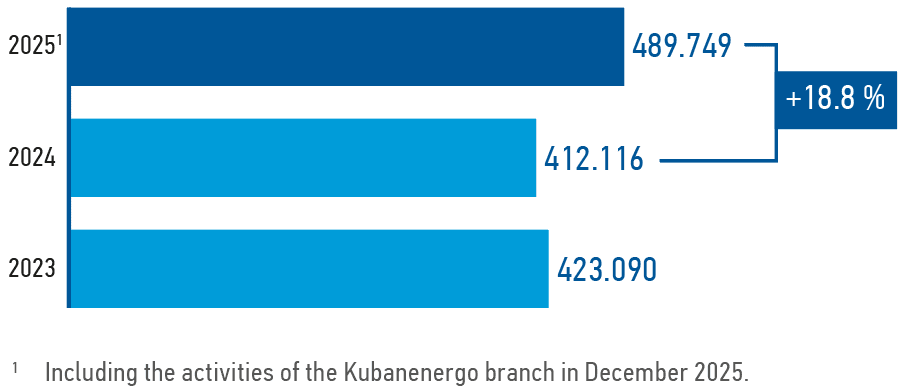
Work-related injuries and ill-healthIncluding the activities of the Kubanenergo branch in December 2025.
GRI 403-9, 403-10
The Company follows the Occupational Safety Policy of Rosseti Group, approved by Order of PJSC Rosseti No. 412 dated 21 September 2023.
The policy is communicated to all persons, contractors working on behalf of the Company and visitors to the Company during the induction briefing.
The policy represents the management style and strategy of the top management, expressed in a publicly available document that outlines the employer’s intentions and guarantees compliance with occupational safety requirements.
To implement the policy, as well as the obligations stated therein, and to achieve the objectives in occupational health and safety, the Company plans, develops and integrate measures to implement OHSMS procedures.
Assessment of working conditions
A special assessment of working conditions is a unified set of consecutive measures aimed at identifying harmful and/or hazardous factors in the working environment and work processes and assessing their impact on employees, taking into account any deviations from the standards (hygiene standards) for working conditions established by the federal executive authority authorised by the Government of the Russian Federation and the use of individual and collective protective equipment for employees.
Employees who perform their duties at workplaces that do not meet state regulatory requirements for occupational health and safety are paid compensation for work in hazardous working conditions, are granted additional paid leave, increased wages, and are provided with milk or other equivalent products (monetary compensation).
For protection against harmful and (or) hazardous factors of the production environment and (or) pollution, as well as at work performed in special temperature conditions, employees are provided free of charge with personal protective equipment and washing agents that received confirmation of conformity in accordance with the procedure established by the legislation of the Russian Federation on technical regulation. The Company’s personnel are provided with personal protective equipment to the full extent.
In order to monitor, control and evaluate the OHSMS performance, the health of employees is monitored, including preliminary and periodic medical check-ups (examinations) and psychiatric examinations.
In accordance with legal requirements, the Company organises medical check-ups: once every two years for employees whose workplaces are found to have harmful and/or hazardous production factors and for vehicle drivers, and every year for persons authorised to work at heights.
In 2025, occupational health and safety measures required by law were fully completed at the Company. In addition, a number of measures were put in place to improve the staff relations, develop a culture of safety, identify risks of ineffective occupational health and safety management systems, and take timely response actions.
Injury rates in 2025
Despite the work carried out in 2025, PJSC Rosseti South had five accidents, resulting in:
- 3
cases – electrical injuries and electric arc burns (1 employee was killed (Volgogradenergo) and 2 employees were injured (Volgogradenergo, Rostovenergo); - 1
case – serious injury as a result of a traffic accident due to a violation of traffic rules by an outside driver (Rostovenergo); - 1
case – minor injury due to personal negligence (Volgogradenergo).
Two accidents (with serious and fatal outcomes) occurred in electrical installations not owned by the Company, during work performed under income-producing contracts for additional revenue.
A review of the factors contributing to workplace accidents revealed a recurring pattern of non-compliance with organisational and technical protocols for safe work practices, unauthorised expansion of jobs assigned, and failure to use protective equipment by those affected.
Indicator | UoM | 2023 | 2024 | 2025 |
|---|---|---|---|---|
Work-related accidents | ||||
For employees | ||||
Number of work-related casualties, number of work-related fatal accidents | person/accident | 0 | ||
Number of people injured in work-related accidents with severe injuries, number of work-related accidents with severe injuries | person/accident | |||
For persons who are not employees, but whose job and (or) workplace is controlled by the Company | ||||
Number of work-related casualties, number of work-related fatal accidents | person/accident | 0 | 0 | 0 |
Number of people injured in work-related accidents with severe injuries, number of work-related accidents with severe injuries | person/accident | 0 | 0 | 0 |
Work-related ill health
No cases of work-related ill-health among the personnel of PJSC Rosseti South were registered in
Industrial safety
In 2025, PJSC Rosseti South operated 130 hazardous production facilities of hazard classes III and IV (hereinafter referred to as HPFs), all of which are registered in the Unified State Register of Hazardous Production Facilities.
In order to prevent accidents at the hazardous production facilities of PJSC Rosseti South, technical machinery is to be operated in accordance with the requirements of regulatory legal acts in the field of industrial safety by trained and certified employees of the Company.
In 2025, the following measures were put in place to promote industrial safety:
- Technical inspections and industrial safety assessments of technical units used at hazardous production facilities (748 technical inspections and 485 assessments);
- Insurance against civil liability of owners of hazardous facilities in case of damage caused by accidents at hazardous facilities was arranged under a contract with a specialised organisation;
- Industrial safety training was conducted for 896 employees, industrial safety certification was provided for 728 employees;
- As part of the ongoing process to ensure compliance with industrial safety regulations, 362 inspections were conducted and 903 corrective measures were developed to address the identified issues. The measures were completed within the set timelines;
- In order to ensure readiness for action to contain and mitigate the consequences of accidents at Class III hazardous production facilities (gas consumption networks), emergency response plans were drawn up and approved, and agreements were concluded with emergency rescue services for the operational servicing of hazardous production facilities;
- Actions to be taken by managers and specialists in the event of emergencies and incidents at hazardous production facilities were defined. Actions related to technical investigation and documentation, recording and analysis of accidents and incidents are approved within the framework of the regulations on industrial safety control at hazardous production facilities of the Company and the Procedure for technical investigation, recording and analysis of causes of incidents at hazardous production facilities of PJSC Rosseti South.
In 2025, no accidents or incidents were recorded at hazardous production facilities of PJSC Rosseti South.