Key risks
Preferred risk (risk appetite) of the Company and its target indicators
Risk assessment shall comply with the Company’s Risk Assessment and Monitoring Policy. Each identified risk is to be assessed to determine its materiality, taking into account the consequences of the risk materialising and the likelihood of it occurring. Risk assessment involves the use of qualitative and quantitative approaches, or a combination of both.
The impact of risks on the Company’s activities is assessed at three levels of materiality, which provide a summary assessment of the probability and consequences of the risk materialising:
critical – unacceptable for the Company and subject to priority managementsignificant – have a significant impact on the Company’s operations and are subject to managementmoderate – have no material impact on the Company’s operations, subject to continuous monitoring
Sr. No. | Risk ID | Risk description | Risk materiality | Risk management |
|---|---|---|---|---|
1 | SR-2 | Deterioration of macroeconomic conditions affecting the Company’s operations | Significant | Where there is an actual decrease of over 30% in the volume of electricity transmission services provided compared to the approved parameters of the business plan for the current reporting period (year) due to objective geopolitical, macroeconomic, man-made, natural and other factors, it shall initiate a change in the approved parameters of the Company’s business plan for the current year in terms of reducing the volume of electricity transmission services provided |
2 | SR-4 | Failure to achieve the Digital Transformation Strategy indicators | Significant | Monitoring of information resources, regular interaction with leading manufacturers of domestic software platforms and solutions in order to assess compliance with the necessary requirements for specific classes of software used in the Company. Working with leading domestic platform and solution providers to create test sites to determine the readiness of their solutions for the Company’s needs. Preparation of a business plan for the new financial year, making sure to meet the required share of spending on Russian software and related work (services) in the total spending on software and related work (services) |
3 | OR-2 | Work-related accidents | Critical | Working with staff in accordance with the requirements of regulatory legal acts in the field of occupational safety. Provision of personal protective equipment and washing agents that have been certified in accordance with the procedure established by the legislation of the Russian Federation, in accordance with occupational health and safety requirements and established standards for employees engaged in work with harmful and/or hazardous working conditions, as well as work carried out in special temperature conditions or involving contamination. Checking that safe working conditions are in place, that employees follow health and safety rules, and that they use personal and collective protective equipment in a correct way. Implementation of measures of the comprehensive programme to reduce risks of personnel injuries |
4 | OR-5 | Overrun of the established target value for electricity losses, % | Critical | Implementation of programmes to reduce electricity losses and programmes to develop smart electricity metering. Scheduling of loss-prevention measures at feeders/transformer substations that are hot spots for electricity losses |
5 | OR-6 | Failure to comply with deadlines for grid connection | Significant | Ensuring the fulfilment of the Company’s accumulated obligations under previously concluded grid connection contracts. Organisation of control over the timely execution of grid connection contracts(at each stage: development of technical specifications, calculation of the cost of grid connection, conducting of trade and procurement procedures, conclusion and execution of work contracts, execution of grid connection contracts using in-house resources), including automation of grid connection activities. Claims and litigation work to monitor the applicant’s compliance with the deadlines for implementing grid connection measures. Timely preparation of materials and their submission for approval of the investment programme in accordance with applicable law. Monitoring and conducting of scheduled checks on the activities of the grid connection |
6 | OR-7 | Failure to comply with the commissioning schedule | Significant | Control over the timing of procurement procedures, conclusion of contracts for the preparation of preliminary permissions, design and survey work, and construction and installation work. Control over the fulfilment of contractual obligations by contractors. Control over the implementation of investment project schedules. Control over the implementation by the Company’s branches of measures related to the commissioning of facilities in accordance with the procedure for commissioning completed facilities |
7 | OR-9 | Disruption and/or cessation of the functioning of critical information infrastructure facilities as a result of computer attacks | Significant | Administration of information security systems. Timely purchase and renewal of licences for specialised software. Timely maintenance of information security tools. Funding for licence purchases and manufacturer’s support |
8 | OR-10 | Unauthorised access to confidential information | Significant | Briefing of newly hired employees Regulation of processes in the field of confidential information protection Official investigations into breaches of confidentiality |
9 | OR-12 | Failure to achieve the required staffing levels | Significant | Organisation of staff recruitment (from the external labour market, talent pool). Organisation of staff training |
10 | FR-1 | Failure to achieve the planned level of revenue from electricity transmission services | Significant | Organisation of staff recruitment (from the external labour market, talent pool). Organisation of staff training |
11 | FR-3 | Failure to achieve the planned level of revenue from additional (non-tariff) services | Significant | Execution of activities under the roadmap for the development of additional (non-tariff) services |
12 | FR-4 | Exceeding the planned level of uncontrolled operating expenses for the purchase of electricity to compensate for losses, for the payment of services for the transmission of electricity via TGO grids, via the UNPG | Significant | Working with TGOs and PJSC Rosseti to agree on planned service volumes for the next regulatory period, including declared capacity, for subsequent planning and submission to state tariff regulators. Contacting the executive authorities of the constituent entities of the Russian Federation in the field of state regulation of tariffs in relation to the tariff balance solutions adopted for the current accounting period |
13 | FR-6 | Exceeding the planned level of interest expenses | Significant | Negotiations with representatives of banking organisations on reducing (not increasing) interest rates. Auctioning to attract credit resources, with the total amount of auctions broken down into several lots, establishment of basic lending parameters based on existing conditions in current loan agreements and monitoring of indicative lending rates of banks to attract more participants to the procurement procedures. Quarterly monitoring of compliance with covenant restrictions under loan agreements |
14 | FR-7 | Overrun of overdue accounts receivable for electricity transmission services | Critical | Imposition of penalties (forfeitures) on counterparties that have violated payment deadlines, as provided for by Federal Law No. 307-FZ. Monitoring of payments and coordination of monthly payment schedules with guaranteeing suppliers. Restriction of the consumption regime in respect of counterparties that violate the terms and conditions of concluded agreements on payment for electricity transmission services rendered. Interaction with the Federal Bailiff Service of the Russian Federation in aid of execution, signing of cooperation agreements with the Federal Bailiff Service of the Russian Federation, control over debt repayment within the framework of enforcement proceedings on received court decisions on collection of overdue debts. Initiation of bankruptcy proceedings against debtor companies that are persistent non-payers |
15 | FR-8 | Overrun of debt burden level | Significant | Managing the Company’s debt position — controlling debt position limits Formulation and implementation of a programme to improve operational efficiency and reduce costs. Implementation of measures to reduce overdue receivables for electricity transmission services and settlement of disagreements, control over achievement of the planned level of electricity payment collection |
16 | FR-11 | Failure to achieve planned financial results from electricity sales | Significant | Monitoring and forecasting of electricity consumption broken down by voltage levels, according to which the price (tariff) for the electricity supplied is differentiated, and by consumer categories |
17 | LR-1 | Violation of antitrust legislation | Significant | Monitoring of events under the risk assessment process, reporting to responsible structural units |
18 | LR-2 | Violation of labour legislation | Significant | Provision of the Company with qualified personnel who meet the job requirements for solving the current and future tasks of the Company. Timely and high-quality provision of the Company’s needs for highly-qualified specialists to fill key positions and vacant positions of department heads. Provision of advanced training for the Company’s employees, organisation of professional retraining of personnel, monitoring compliance with legislative requirements in the field of compulsory training, ensuring compliance with the mandatory requirements of external control/supervisory bodies. Ensuring compliance with labour legislation and the Company’s by-laws and implementation of talent decisions. Determination of professionally important psychological and psychophysiological qualities of employees/job candidates |
19 | LR-3 | Violation of occupational health and safety legislation | Significant | Ensuring that employees have the requisite competence and awareness in occupational safety matters. Planning of occupational health and safety measures, subject to changes in state regulatory requirements for occupational health and safety. Organisation and control of timely implementation of measures |
20 | LR-4 | Violation of industrial and fire safety legislation | Significant | Planning and implementation of measures aimed at ensuring fire safety (maintenance and repair of automatic fire alarm systems, warning systems, smoke protection systems and other automatic fire protection systems; operation of fire water supply systems; inspection and recharging of fire extinguishers; fire protection treatment of building structures and cables; purchase of primary fire extinguishing and fire protection equipment; training and education of personnel in fire safety; purchase of personal protective equipment; purchase of placards, stands, training aids, evacuation plans, etc.). Planning and implementation of measures aimed at ensuring industrial safety (conducting industrial safety assessments, inspection and maintenance of lifting equipment, insurance of hazardous production facilities, obtaining licences for the operation of hazardous production facilities, pre-examination and pre-certification training of personnel, industrial safety training) |
21 | LR-8 | Violation of tax and accounting legislation | Significant | Staff training and skill improvement. Current analysis of tax accounting registers, verification of the accuracy and completeness of tax payments |
22 | LR-9 | Corruption-related offences by Company employees | Critical | Implementation of measures of the Anti-Corruption Plan of PJSC Rosseti South for 2025 |
23 | LR-10 | Unlawful actions of legal entities and individuals, including employees of subsidiaries, causing economic damage and harm to business reputation of the Company | Significant | Verification of counterparties for concluded contracts. Checking pricing for concluded contracts |
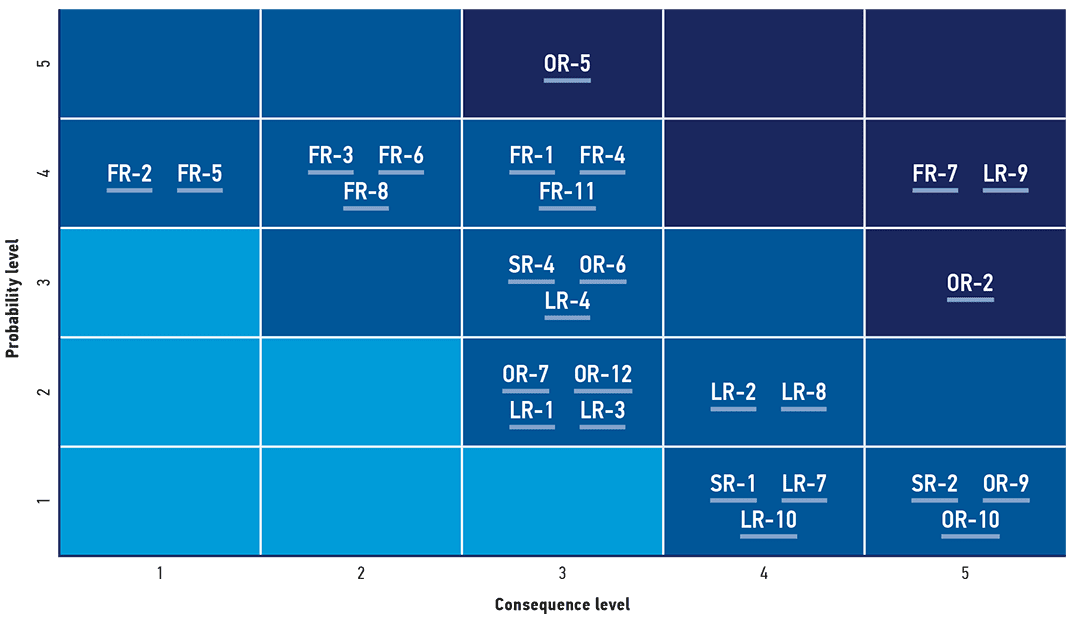
Information on the realisation of critical and significant risks is reviewed by the Company’s management bodies as part of the report on the organisation, functioning and effectiveness of PJSC Rosseti South’s risk management and internal control system (RM&ICS) for 2025.
Information security risks and cyber threats
Risk of disruption and/or cessation of the functioning of critical information infrastructure facilities as a result of computer attacks
The risk is assessed as significant with a high level of consequences from the realisation of the risk. The main reasons for this risk could be the lack of up-to-date licenses and software, as well as delayed maintenance. In order to reduce (minimise) the realisation of this risk, the Company administers information security systems, ensures timely purchase and renewal of licences for specialised software, timely maintenance of information security tools, financing the purchase of licences and technical support from the manufacturer.
Risk of unauthorised access to confidential information
The risk is assessed as significant with a high level of consequences from the realisation of the risk. The main reasons for this risk may be illegal actions of third parties, violation of the requirements of regulatory documents by the Company’s employees.
In order to reduce (minimise) the realisation of this risk, the Company carries out as follows:
- Briefing of newly hired employees
- Regulation of processes in the field of confidential information protection
- Official investigations into breaches of confidentiality.
Risks pertaining to sustainable development
Environmental risks
Given the extent to which production activities affect soil, atmospheric air, surface and subsurface subsoil, flora and fauna, the Company places considerable emphasis on mitigating adverse effects on these natural environment components and guaranteeing environmental safety at power grid facilities.
Risks related to the Company’s environmental impact are long-term in terms of time of impact and are assessed by the Company as moderate, given the set of environmental risk management measures in place.
In order to minimise these risks, the Company ensures compliance with the requirements of environmental legislation during the production process. Furthermore, ongoing training for personnel is focused on enhancing their capacity to detect and recognise potential infractions of environmental regulations. The Company ensures that the volume of direct greenhouse gas emissions is accounted for in accordance with the requirements of the current legislation of the Russian Federation.
Climate risks
The risks associated with the impact of climate change on the Company’s operations are short-term in terms of impact time, have a significant level of consequences, are assessed by the Company as moderate and may have a negative impact on the quality and reliability of energy supply, production activities and financial results.
First of all, climate risks are associated with an increase in the average annual air temperature. High outdoor air temperature in summer, typical for the region of the Company’s presence, may entail the risk of overloading power supply centres, which will deteriorate the power supply to consumers. In order to minimise this risk, the Company continuously implements routine measures to redistribute loads between power centres, includes power centres power augmentation measures in the Company’s investment programme, and repairs facilities according to their technical condition, taking into account risks and data on outages.
In addition, changes in conventional climatic conditions can cause natural emergencies. In the regions where the Company operates, there is a risk of natural disasters such as hurricanes, heavy rainstorms, floods, snowstorms, mudslides and freezing rain. These events can cause material damage to the local population, housing, public utilities, social facilities and the Company’s power grid. As a result, power supply and transportation links in the region may be disrupted.
In order to minimise the impact of adverse weather conditions, the Company takes the following steps:
- Monitoring of weather conditions on an ongoing basis with the development and execution of action plans to reduce the impact on the Company (during spring high water and floods; during the thunderstorm season);
- Preliminary planning and adjustment of equipment repair schedules, taking into account weather conditions;
- Emergency response and restoration works;
- Interactions with the insurance company to obtain compensation for damage caused to the Company’s insured property as a result of natural disasters;
- Notification to the general public through the media, radio and television about the danger of approaching and being in electrical installations, the inadmissibility of violating the requirements of the rules for the protection of power grids.
Social risks
Social rights extend to fair and favourable working conditions, protection from unemployment, fair and satisfactory remuneration, equal pay for equal work, the possibility of maintaining the health and well-being of a person and their family, improving the level of education of the Company’s employees, and corporate support for enhancing the living conditions of staff.
Risks related to non-compliance with social rights and guarantees of employees are medium-term by time of impact. Given the Company’s high level of responsibility in the context of its social commitments, this risk is assessed as moderate with a low level of consequences if realised.